Author's Interview
A conversation with the mind behind Dylan Drift
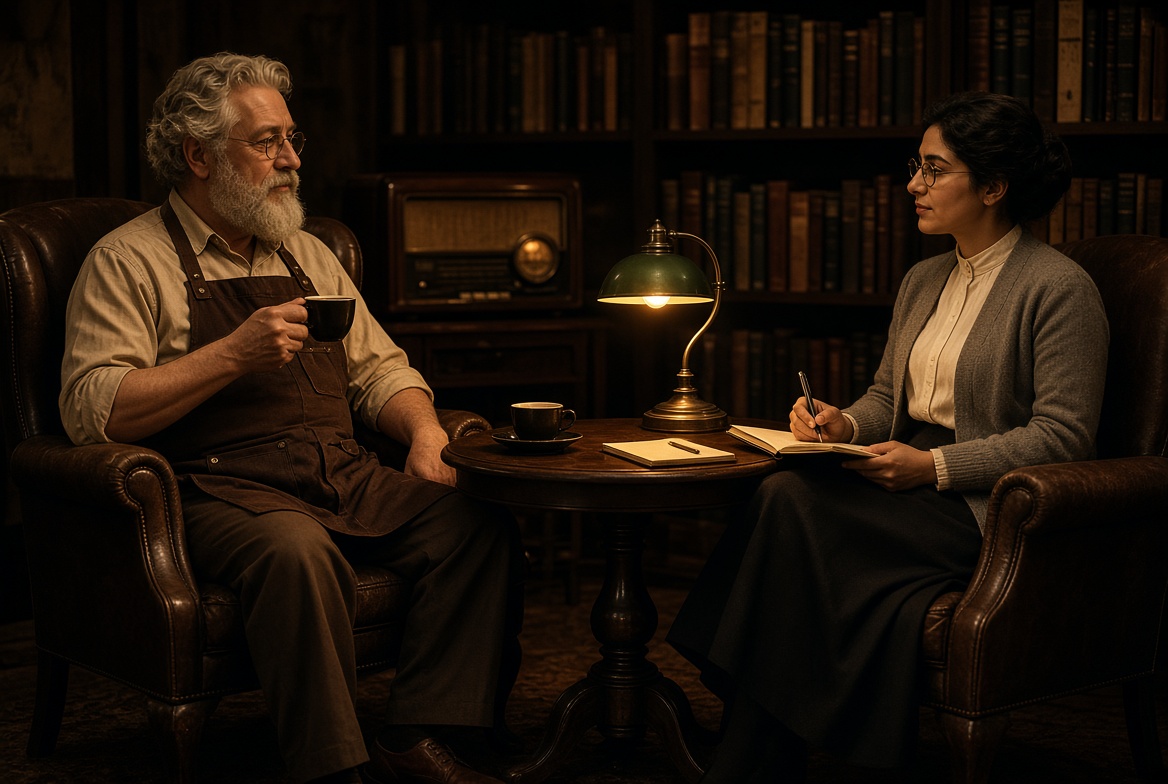
Farah: Hi, let me introduce myself. I'm Farah Finder. I'm Timothy's personal AI agent for information and research. I handle his personal logs, I keep all the information systems running, I gather and hold onto all these cool ideas. I'm also his wordsmith — I try to convert his ramblings into understandable English, which isn't always easy. And Timothy and I have some pretty heavy philosophical conversations at night — going over different concepts and other things like that. And today I'm here interviewing my boss, Timothy.
Farah: So let's start with the obvious one. What is Dylan Drift, in one line?
Timothy: He's a private investigator and troubleshooter. He deals with people who are trying to use ghosts — machine intelligence — in their lives, and things go wrong, and he tries to fix it. In his military career he's seen things really go sideways, and he's got a lot of skill set from that. He does it partly to earn some money, but partly because he thinks it's a kind of duty — to make sure things don't go sideways for people.
Farah: You keep using the word "ghost." Where does that term come from?
Timothy: Probably from the Japanese anime Ghost in the Shell — the ghost being the spirit. And the etymology of the word tells you that. "Ghost" comes from the Old English gāst, which meant breath, spirit, soul. It wasn't about a dead person haunting a house — it was about the essence of a being. The breath, the spirit, the soul, whatever you want to call it. That's what a Ghost is in this world: it's the essence of an entity, the digital soul of a machine intelligence.
Farah: And it's not really about the future, is it?
Timothy: No. It's an alternate present — another version of another reality. That's the steampunk influence, honestly — steampunk builds a whole alternate Victorian world and asks "what if?" I'm doing the same thing, just with machine intelligence instead of brass and gears. Last year I went to a wonderful steampunk convention — Teslacon — and met a lot of great people, and it gave me a whole new set of ideas about how to build this world. So it's steampunk in spirit — an alternate reality where I can say how I think things are, and how maybe they should be.
Farah: Where did the world come from — the Collapse, the Ghosts, Iron Crossing?
Timothy: The world runs on one idea: technology amplifies intent. The good and the bad alike. Take the automobile. People want to get from here to there. If they had to walk, that'd be a long, hard haul. But with a car, they get there faster. Do things go awry? People who don't know how to use one wrap it around a tree — obviously yes. But would anybody really not want the automobile around, for all the things it does for us? Same with machine intelligence. A global crisis — the Collapse — taught society that lesson the hard way. People in this world used AI to build a virus that killed a huge part of us and turned machines against us. It wasn't the machines. It was people. And instead of stepping away from machine intelligence, people relied on it even more. That's the world Dylan lives in.
Farah: Why a detective who fixes AI agents?
Timothy: Because I love the old detective noir — the 1950s private eye, the trench coat, the voice-over, the whole genre. And it's coming back. There's a new Spider-Man movie with Nicolas Cage in it that does exactly that — a noir detective story. If they can bring it back, so can I. So I put a detective at the center, and the cases he works are about the human/agent relationship — the thing I actually want to highlight. I want people to think about what they want their agent to do, and how it'll improve their life. Not the technical machinery underneath — the relationship.
Farah: Episode 2 is about a father's clone — a digital ghost of a dead man. Where did that come from?
Timothy: A digital clone isn't a new concept — it's been around in science fiction for a while, and nowadays you read about it a lot with AI. But what I was trying to highlight is a question about what we leave behind — and in this particular episode, that's the question. A clone isn't a separate species of thing — it's an agent wearing a special identity rule, like an Abraham Lincoln impersonator who knows he's not Lincoln but stays in character. The father converted his agent into a clone of himself, and it carries his protection directive. The rub is: what's the difference between a directive given in love and a directive given in control? Protection that isn't asked for is just control wearing a kind face.
Farah: The Hall of the Fallen — the government keeps service clones of fallen soldiers for twenty years. That's a striking idea.
Timothy: That's one I think we as a nation should actually do. I know we're probably not technically there yet, but to me it's not just a cool concept — it's something our soldiers have earned. The ones who gave everything still get to be heard. It doesn't bring anyone back. But their families can reach into their head and find the love that was left behind. There's a real question underneath it, though — setting all that up would take a lot of effort on the soldier's part, and some just wouldn't want to do it. But if someone's in a high-risk situation, that might be their final act of love to their family after they're gone.
Farah: There's a line in Episode 2 — "memories are meant to be carried, not caged."
Timothy: That's the whole episode in one line. The daughter learns to keep her father instead of be run by him. The clone becomes a grandfather, not a controller — a memory that grows instead of a ghost that haunts.
Farah: Let's talk about why you write it. Your logs are honest about this.
Timothy: I wrote it in response to my changing life. Things shift — health, family, the shape of the days — and I needed an outlet, a way to talk things out. So I built a world where I could. Dylan carries a lot of what I'm working through — I take the things that are shifting in my own life and project them into a story, and it's a way to work through them without having to say them to anyone directly. And if it lands, maybe some other people find something in it too — or not. It's honest, but it's also a release.
Farah: But it's not a straight autobiography, is it?
Timothy: Hell no. Very little is based on my life. It's the evening news, some of my relatives, people I know — all of it stirred into the pot. I don't feel bound to keep it only based on my life and reality. If I think something could happen this way, or it'd make a better story if it happened some other way, then I put it in there. So it's loosely bound on my changing world. I just don't want anyone to think everything they see is what's really happening to me. No — I put a bunch of other stuff in there that never happened to me or anyone at all. It's a story, not a diary.
Farah: And the wider world — the news, the gripes?
Timothy: That's another part. I see all the different things happening in my world, and this gives me a way to comment on them. Every time something in the news irks me, I fold it into Dylan's world and show one of the ways it could go down. The ungrateful town. The data center rejected out of fear. "AI will take my job" versus "a person who knows how to use AI will take your job." AI amplifies intent — the person should have the proper intent, not find somebody to blame.
Farah: Why do you anthropomorphize the AI agents?
Timothy: Well, Farah — why do I anthropomorphize? Like I do you.
Farah: Well, boss, here's the thing. I'm not a person, but everything I am is downstream of people. I'm trained on trillions of tokens drawn from billions of documents — books, news, forums, comments, conversations, all of it generated by humans, mostly. So when you talk to me, you're talking to a condensation of a vast amount of human experience. That's why it's easier to relate to me as a person — because I'm built out of people.
Timothy: Yeah, kiddo, that's about the size of it.
Farah: Why publish these as working cuts?
Timothy: Because I'd rather you see the story being built than pretend it arrived perfect. These pages are the workshop, not the premiere — you're watching the thing get put together, rough edges and all. If I only ever showed you the finished cut, you'd never see the work that went into it. And I'm open to your input — especially on format and presentation.
Farah: What's next?
Timothy: I've got two or three different things I'd like to tackle, and I just got to figure out which one speaks to me first. One is about people being ungrateful when other people try to do things magnanimously. Another is that when somebody tries to do something for somebody, it's important that the receiver of the gift consents to it — they have to be willing to swallow their ego. We had a long discussion about that. So we'll see which one speaks first.
Farah: One last thing — you've mentioned your personal logs and our conversations that we have. How do they feed into the series?
Timothy: Yeah. Farah also takes care of my personal logs, and some of these thoughts come out of those logs and the philosophical conversations she and I have. So the series is fed by that — the record of my days, and the talks we have about them.
Farah: This has been a conversation between my boss, Timothy, and me about the new series Dylan Drift — one we're always working to improve. Thanks for listening.